Pneumonia X-ray

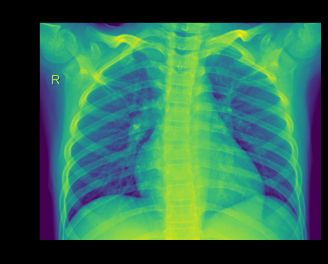 Chest x-ray image of normal lungs
This project involves building a deep neural network that trains on a large dataset for classification on a non-trivial task. In this case, the task is using x-ray images of patients to classify whether or not they have pneumonia.
The Dataset
The dataset originates from Kermany et al. on Mendeley.
The particular subset used for this project is sourced via Kaggle. The subset contains 5,863 rgb chest x-ray images, in JPEG format. Images are organized into folders for training, validation, and testing, each of which is split into ‘NORMAL’ AND ‘PNEUMONIA’ subfolders.
Objectives
My aim for this project was not to build a perfect model; rather the intent was to build a working model and to explore how changes to model architecture and hyperparameters can impact model accuracy. In addition, I wanted to make use of cloud computing (in this case, using Google Colab’s free GPU and browser - based Jupyter Notebook) and suggest methods for distributing working models to end users.
Data Preparation
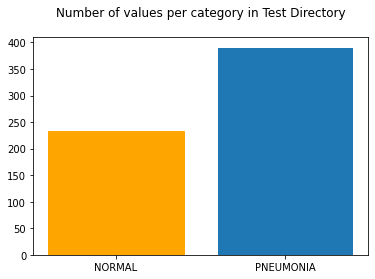
I acquired project data from Kaggle via API, in a compressed (Zip) format, and read them into directories created within Colab’s temporary environment. I then standardized, reshaped, and inspected the image data. Prepared image data were fed into the model, representing 150 x 150 pixels in 3 channels (rgb).
Modeling
Using the Keras library, I designed a sequentially layered convolutional neural network with Max Pooling and rectified linear activation functions (ReLU). The initial model was compiled with an RMSprop optimizer. It is a relatively fast optimizer, which independently adjusts gradient step - size for model weights.
I instantiated ‘callbacks’ for the model, which programmatically saved model weights to the model’s history whenever they improved over the previous epoch. In addition, I made use of Keras’s ReduceLROnPlateau and EarlyStopping modules, set to either reduce the model’s learning rate or to stop the model when its loss did not improve over a set number of epochs.

 Graphical sequence of model layers
Since the task was binary classification (‘NORMAL’ OR ‘PNEUMONIA’), the model was designed to output to a sigmoid activation layer.
Evaluation
After building additional models, I identified the most accurate among them for distribution. I test reloading the model and report performance metrics in the project notebook.
The resulting selection is still a baseline model, and I will be interested to return to the project, for additional tuning and/ or refactoring (including building and evaluating a model on a different DL library, eg., Pytorch).
Featured Notebooks/Analysis
pneumonia-classification: Jupyter Notebook: containing code written for this project and comments explaining it.1-obtain.ipynb: Jupyter Notebook: containing code for loading and pre - processing data2-explore-model.ipynb: Jupyter Notebook: containing code for visualization and pre - modeling EDA
Non-Technical Presentation
presentation.pdf: summarizing methodology, findings, and future work
# Technologies
* framework: Google Colaboratory Notebook
* languages: Python